
| |
|
|
| |
| MEDPIMOLD Technology |
The technology to produce ceramic or metallic parts by Medium Pressure Powder Injection Molding is straightforward and includes the following steps:
- Powder pre-processing
- Feedstock preparation
- Medium pressure injection molding
- Binder removal by thermal evaporation or supercritical CO2 extraction
- Sintering
|
... in brief
A high-solid
content mixture (feedstock) of ceramic or metal powder and a wax-based
binder is melted and injected under pressure into a tempered one- or multi-cavity
mold tool. The solidified molded part
is then ejected from the tool, and the organic binder is removed thermally
in a debinding furnace or, alternatively, by supercritical extraction.
The remaining powder body is sintered (fired) in a furnace at
high temperature to a dense, high- strength component. Typical
linear shrinkage during sintering is 10-15 percent. |
|
 |
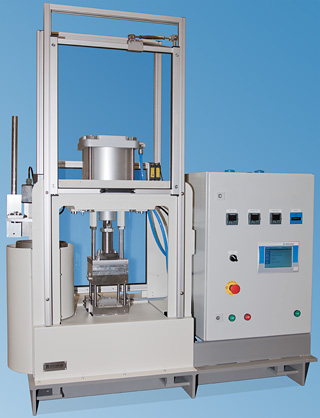
| An automatic one-cavity mold tool for production of watch cases of stainless steel, zirconia as well as alumina. The production rate with this tool is four to five cases per minute. |

Four stages during production of watch cases of stainless steel by medium pressure powder injection molding: 1. injection molded 2. cleaned 3. debound and 4. sintered |
 |
|
 |
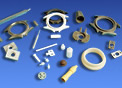
Powder injection molded watch cases and links of washed stainless steel and aluminium oxide (alumina) |
| Complex-shaped metal and ceramic parts formed by
Medium Pressure Powder Injection Molding - MEDPIMOLD - are used
in a number of industrial applications as well as in many consumer products. Our customers have selected it because of the desirable combination of
low-cost, flexibility, and shape complexity. Up till now, parts of
the following materials have successfully been manufactured: |
Metals
- MIM
- Stainless 316 Steel
- High-Speed Steel (HSS)
- Low-Alloy Steel
- Iron
- Tungsten Carbide
- Tungsten
- Cobalt
- Titanium
|
|
Ceramics - CIM
- Alumina
- Zirconia
- Silicon Nitride
- Silicon Carbide
- PZT (Piezo material)
- Leucite
- Steatite
- Glass
|
| With Goceram's
feedstock preparation concept, well-adapted feedstocks with high-solid
content are obtained. For instance, the solid content of stainless
steel powder (grain size less than 16 micrometers) is 65 volume percent and of fine aluminium oxide powder
(mean grain size of 1 micrometer) is 62 volume percent. |
| |
| |
| A
relative comparison of different PIM technologies
| |
Type of injection molding technique |
MEDPIMOLD |
| |
High pressure |
Low pressure |
Medium pressure |
| Investment cost |
high |
low |
medium |
| Molding tool cost |
high |
low |
low |
| Service cost |
medium |
low |
low |
| Automation capability |
good |
unknown |
good |
| Prototyping capability |
poor |
good |
good |
|
| |
| |
| Equipment
and technologies
The GOCERAM
production line includes:
- Feedstock Mixers for rapid
homogenisation of powder and binder
- Medium Pressure Injection
Molding (MPIM) Machines for cost-effective shaping of complex
components using environment-friendly wax-based binder systems
- Debinding Furnaces without
or with weight loss rate control, documenting the removal
of binders and other volatiles from green parts in various atmospheres
- Supercritical CO2 Extraction
Equipment facilitating high-speed production of thin- and thick-walled
parts to very fine tolerances
- Specially designed sintering
furnaces
- Automation equipment
Experienced customers may purchase selected machinery
only. For customers completely new to the technology, Goceram
will be involved all the way from the first test run to the start
up of the production at the client's manufacturing site.
Please contact us if you want us to carry out a
test run of a specific material and component according to your
wishes. We will do this as a technical service and share the cost
between us. Such a run will help you to decide that MEDPIMOLD
is the technique you should choose for the production of complex
shaped parts of almost any material.
The trademark MEDPIMOLD® covers all the machinery
and technology related to the Medium Pressure Powder Injection
Molding technique. |
|
|
| |
|
|